
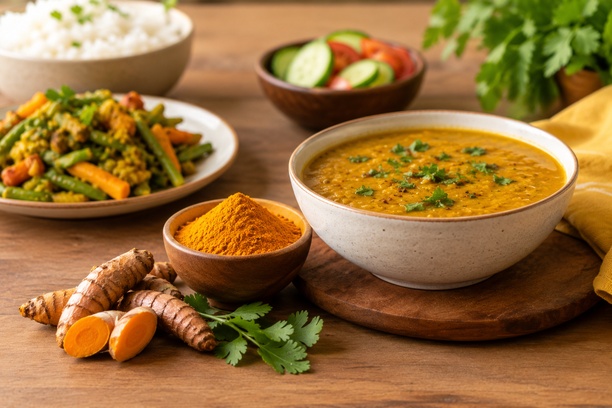
Turmeric has earned its place as an essential ingredient in most Indian kitchens. Only a little bit of turmeric is needed to make a plain dal dish take on a golden hue, enhance the taste of vegetables, and give off its typical earthy smell. Since there has been much talk about the nutritional aspects of turmeric lately, it is quite natural to think that the more we use, the better it will be for us. However, it seems that this is not always the case.
Usage of turmeric is generally in small amounts. Turmeric is not used like any grain, pulse, vegetable, or fruit. It is basically used for flavoring purposes. In a home-cooked recipe, a small amount of turmeric may be sufficient to provide the color and flavor of the spice. There is no need to use huge amounts just because it contains natural substances. Consider this spice like cumin, coriander, black pepper, or cardamom – small quantity does a lot for the overall meal.
One of the easiest ways to include turmeric in your diet is not to create a special turmeric routine at all. Simply continue using it in familiar foods such as:
This approach keeps turmeric where it has traditionally belonged—in everyday food.
Once an ingredient catches on because of its nutritional value, there is a tendency to consume very large quantities of it. However, consuming excess quantities of any spice does not necessarily imply that a person’s diet will be healthier. To achieve balance in a person’s diet, he needs to eat a wide variety of foods. Vegetables supply the body with various vitamins, minerals, and phytochemicals; pulses supply proteins and fiber, whereas whole grains provide the body with carbohydrates.
Sometimes, turmeric is viewed as an element that should be taken separately from one’s meals. The fact is that there are plenty of options for incorporating it into Indian dishes. Incorporating turmeric during the process of making dal or cooking vegetables allows the spices to be included in a meal, not becoming a separate process of maintaining one’s health. It is also more convenient since one does not have to do anything extra when the spices are already used for food cooking.
There exists a difference between turmeric as a spice in the kitchen and the supplements of concentrated turmeric or curcumin. A spice that is consumed in the food you eat in your daily diet in small amounts. The supplements might have concentrated amounts of certain components, and so on. So just because turmeric is a traditional food ingredient does not mean that the supplements will be right for everyone. Anyone interested in the turmeric or curcumin supplements especially when taken with medicine and for certain medical conditions must consult with a healthcare professional.
In the case of turmeric consumption on a daily basis, quality is essential. It is recommended to have turmeric which has a natural smell, colour and looks neat. There are many varieties of turmeric which may naturally differ in terms of smell, colour, taste, and even chemicals. For instance, Lakadong turmeric is a special variety of turmeric traditionally grown in Meghalaya. However, choosing a certain type of turmeric does not imply that one should eat more of it.
There is no need to make the turmeric an overly elaborate mathematical equation within the diet. Simply use it in a quantity that will satisfy the taste and flavor of the food and continue to ensure balance and variation in other foods eaten. The best possible perspective to have when it comes to turmeric is as just one ingredient amongst others.
Turmeric has been traditionally used for generations in Indian cooking without any special rituals. No need for complicated practices was required in order to introduce turmeric into one’s diet. Just a little bit in dal, a dash in veggies, or sprinkling some into khichdi can help you to incorporate this wonderful spice into your daily routine. In some cases, the simplest way is also the most sustainable one: eat healthy food and cook well, and turmeric will remain the yellow spice that it has always been.
Haldi in Indian Traditions: The Golden Spice Beyond the Kitchen
September 16th, 2026
How to Check Tea Quality at Home: A Simple Guide to Better Tea
September 8th, 2026
Health & Nutritional Benefits of Hing: Why This Traditional Spice Still Matters
September 3rd, 2026 App Store
 Play Store