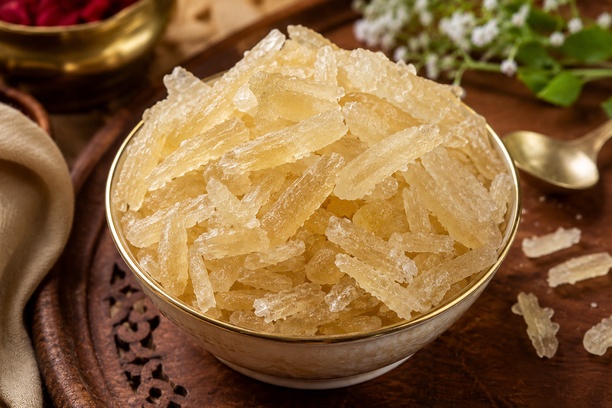
Mishri Dhaga is a natural Indian sweetening agent known for its distinct crystal strands, subtle sweetness, and multiplicity of applications. As opposed to regular sugar, the bigger crystals of Mishri are what give it its unique texture and popularity as a dessert sweetening ingredient in post-meal occasions, mixing into drinks, and special ceremonies. For generations now, Mishri has been part of Indian cuisine customs and traditions. The simplicity of its sweetness and crystal texture has made it a versatile sweetening agent.
Sweeteners are not just about taste. There can be other factors that matter in choosing sweeteners like texture, ease of use, cultural value, and versatility. The Mishri Dhaga is an example of such a sweetener.
Mishri Dhaga adds some traditional element into your daily experience of sweetness. These are large crystalline strands of sugar which are different from ordinary sugar.
These crystals will give you sweet taste in the simplest form without any special preparation required. You can use small amounts as per your choice.
Mishri Dhaga can be mixed in hot milk, tea, other herbal drinks and beverages. They dissolve slowly and easily and hence can be used as required by consumers to add sweetness to their beverage.
Mishri is normally consumed after eating in many Indian homes. The crystalline form of Mishri makes its consumption easy in small quantities and it is often accompanied with other ingredients used to clean mouth after meal.
Mishri Dhaga has got great significance in India and hence its use is common in puja, prasad and offering in other religious ceremonies.
Large crystals make it easy to consume just the needed quantity. If you want to flavor your milk or have some after dinner, Mishri Dhaga is easy to portion.
The most prominent feature of Mishri Dhaga is its versatility. It is easy to integrate into everyday practices.
| Use | How It Can Be Used |
| Warm Milk | Add a few crystals for sweetness |
| Tea | Use instead of regular sugar according to taste |
| Herbal Drinks | Add to balance naturally strong flavours |
| After Meals | Enjoy a small quantity traditionally |
| Puja & Prasad | Use for religious offerings |
| Mouth Freshener | Combine with traditional ingredients |
| Festive Occasions | Serve as a simple traditional sweet |
Both Mishri Dhaga and sugar offer the same feature of sweetness, but may vary in their physical appearance and uses.
| Feature | Mishri Dhaga | Regular Sugar |
| Appearance | Large crystal strands | Small granules |
| Texture | Firm and crystalline | Fine and granular |
| Sweetness | Mild, clean sweetness | Conventional sweet taste |
| Traditional Use | Prasad, after meals, beverages | Everyday cooking and baking |
| Portioning | Easy to use crystal by crystal | Usually measured by spoon |
It is important that good quality Mishri Dhaga has a good look, proper crystallization, uniform texture, and proper packaging. Properly formed and long strands are one of the important features of this traditional item. Some consumers also like such products which are unbleached and unsulphured and retain their traditional look.
In a world full of various kinds of sweetening agents, Mishri Dhaga manages to make its own space due to its traditional look, crystal structure, adaptability, and sweet taste. From enjoying it in warm milk to adding it in your favourite drink to eating it after a meal or even offering it for puja and prasad, Mishri Dhaga can be used on various different occasions. For everyone who wants to add some traditional element to their kitchen, Mishri Dhaga is a perfect option .
How to Identify Pure Groundnut Oil: Simple Pavitra Tests at Home
August 14th, 2026
Roasted Chana: A Crunchy Snack Packed with Health & Nutritional Benefits
August 13th, 2026
Pavitra Test: How to Identify Pure and Good-Quality Cashew Nuts
August 12th, 2026
 App Store
 Play Store